- College Inside
- Posts
- 'If they ever open the door, watch what I can do'
'If they ever open the door, watch what I can do'
One of the country's first incarcerated professors reflects on two years of freedom.

Charlotte West
March 06, 2026

A biweekly newsletter about education and employment during and after incarceration. Written by Open Campus national reporter Charlotte West.
David Carrillo spent three decades dreaming about getting out of prison. Here's what he's built after two years of freedom.
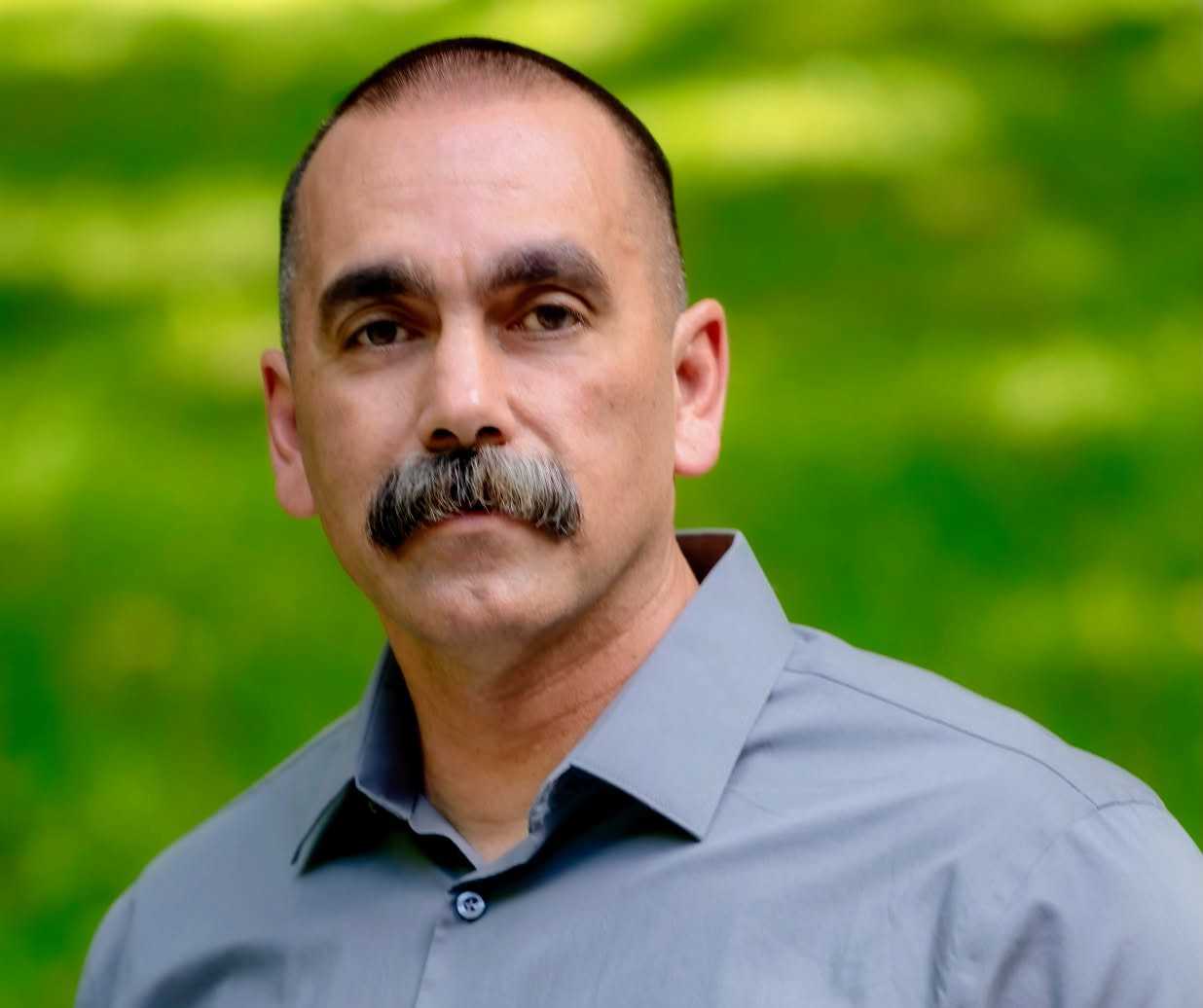
David Carrillo was released in January 2024 after receiving clemency from Colorado Gov. Jared Polis. Photo courtesy of David Carrillo.
In January 2024, David Carrillo became one of the first incarcerated people in the country to teach a college-level course to other incarcerated people — and then, days later, walked out of a Colorado prison after Gov. Jared Polis granted him clemency, citing his educational and professional accomplishments. Open Campus and Chalkbeat Colorado covered that story, which won a first-place feature writing award from the Colorado chapter of the Society of Professional Journalists. This past January, Carrillo marked two years of freedom — and his discharge from parole — with a "freedom bash" celebrating not just his own milestones, but the friends and fellow formerly incarcerated people around him who are out and building their lives. College Inside caught up with him on what the last two years have actually looked like.
This interview has been edited lightly for length and clarity.
Charlotte West: Give me the quick recap — what have the last two years looked like since you walked out the prison gates more than two years ago?
David Carrillo: I had numerous ideas of what I'd like to do if I was ever released from prison — because I was doing life without the possibility of parole. I used to dream up ideas all the time. I would say to people, if they ever opened up the door for me, watch what I can do.
When I got out, I finished my ABE [adult basic education] certification through Red Rocks Community College, and they offered me a position as an adjunct instructor. I also continued teaching for Adams State.
I launched my own consulting business focused on plea bargain analysis. It grew out of my years as a jailhouse attorney on the inside, where guys would come to me because they didn't understand what their plea bargain actually meant — how it would affect their classification, their facility, their mandatory programming. They wanted to file ineffective assistance of counsel claims, grievances against their attorneys. That work evolved into what I do now: helping people understand how the type of plea, the type of felony, affects your earned time, your good time — all those elements that get overlooked when someone accepts a sentence.
In addition to your teaching, you also started your own business. Why might entrepreneurship be a good option for people coming home, and what are the real challenges?
I had visions and dreams — and one of the ideas that was ruminating when the door opened was this consulting idea. I needed to pursue it, at least to try. The challenges, though, are real. There's no secure paycheck, no benefits. I have to pay for my own insurance, pay my own taxes. There's a lot that goes into running your own business that people don't really understand until they're living it. Even with an MBA, the books don't teach you the subtleties — especially when it comes to entrepreneurship. I'm discovering new challenges as I go, and doing my best to navigate through them.
You mentioned there's a new full-time position you've taken on — can you give us a preview?
I'm now the lead facilitator for Legislation Inside, or ALLY, at the Corey Wise Innocence Project at University of Colorado Boulder. It's a legislatively mandated, codified program — 40 currently incarcerated individuals, elected by their peers across facilities in Colorado, are involved in public policy. They push forward bills, testify at committee hearings, write letters in support or opposition. I was one of the first elected representatives on the inside, and I testified at the capitol when the bill to codify the program passed. It's a full-time position.
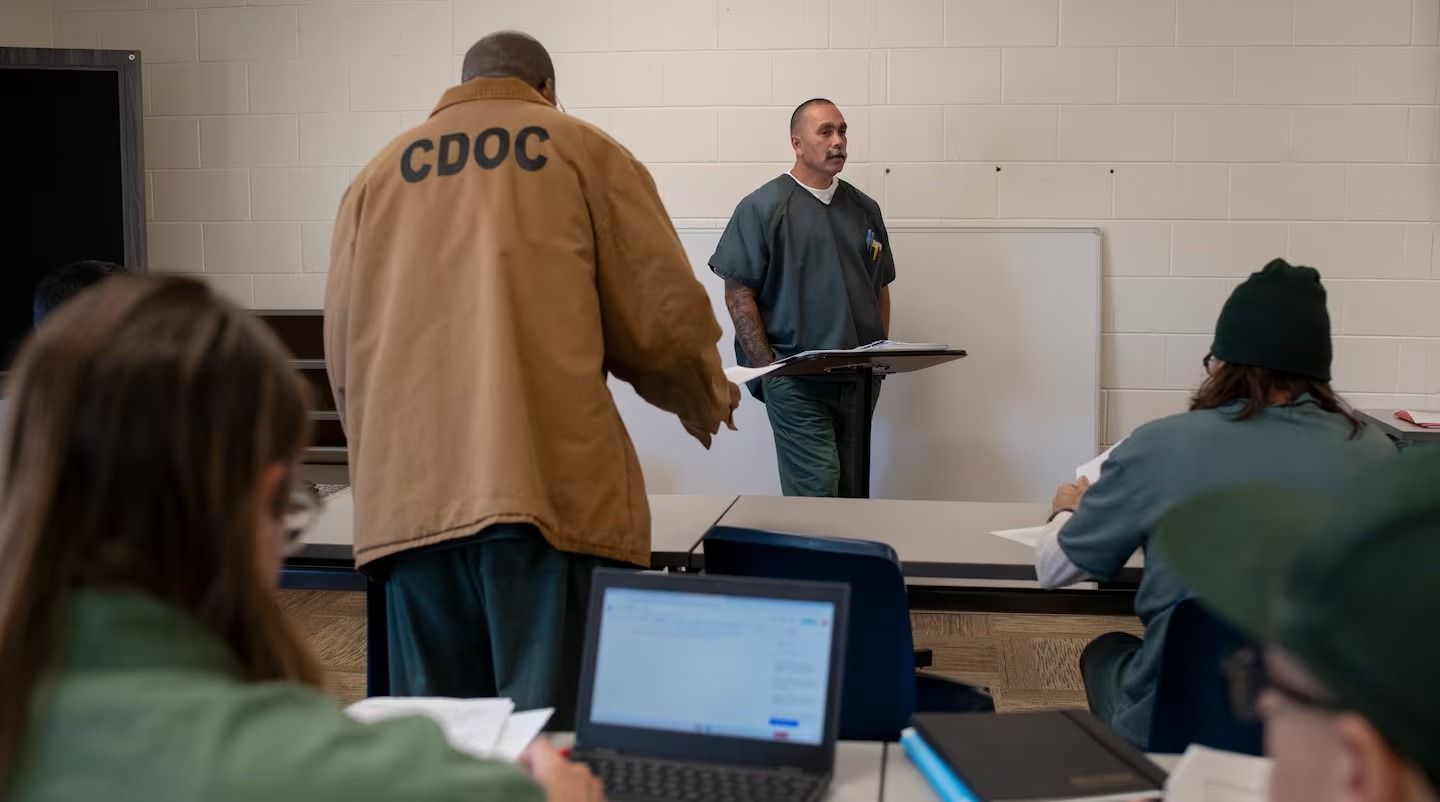
David Carrillo, an adjunct professor with Adams State University, talks to his Intro to Macroeconomics class held in a Colorado prison in November 2023. He was the first incarcerated person in the state to teach a college-level class to other incarcerated people. He was released in Jan. 2024. (Photo: Rachel Woolf for Chalkbeat)
You've stayed involved in prison education since your release — and gotten more connected to the field nationally. What has that been like?
When I was released, I was given a fellowship with Jobs For the Future Horizons, and I was invited to a conference in Washington, DC, where I spoke on higher education in prison. Then I was invited to apply for the first cohort of the Rockwood Leadership program for higher education in prison. And then I went to the National Conference on Higher Education in Prison.
What I didn't realize was the scope of it. I had no idea how many people behind the scenes were even making it possible for me to become the first incarcerated college professor. And then I get to the JFF Horizons conference and there are thousands of people there — formerly incarcerated individuals doing amazing things across the country. Organizations like Ascendium, the Alliance for Higher Education in Prison. I mean, I've met a lot of people. It was great to see how many people out there are working to help provide opportunities for individuals to come home and find success.
You also wrote a memoir. Tell us about it.
It's titled Kiko: From Life Without Parole to Life With Purpose. It wasn't difficult to write — I'd been sharing those stories for years while teaching Seven Habits on the inside. When I came home and everybody was on me about writing my story, I sat down and it came out.
I've been doing author talks at colleges across Colorado — Red Rocks, Pueblo Community College, Colorado Mountain College, University of Northern Colorado. The response has been strong across a lot of different departments: psychology, criminal justice, sociology. I write about entering the foster care system at a very early age, juvenile detention, going into prison as a teenager, solitary confinement — statistically, my life was almost destined to end up in prison. And then how I took control and found myself on the opposite end of those statistics. I became the outlier. I was supposed to die in prison. But here I am.
What were some of the unanticipated challenges of reentry that caught you off guard?
I had listened for years to guys talk about the anxieties of coming home — walking into a store, going to a restaurant, all these people and overwhelming choices. I paid attention and did my best to prepare. And then I found myself sitting in the house one day, my girlfriend at work, no TV on, no music playing, just sitting in this depression, hurting real bad.
And I couldn't walk out the front door. I would look out the window at the street and want to go outside, but I was waiting for someone to call ‘movement’. For years at higher-security facilities, you can't just leave — they have to give you permission, open the door, call movement. I was waiting for permission that wasn't coming. I wouldn't even go into my own backyard. If someone called me up and said, hey, let's meet up, let's go have lunch — that was like permission for me to leave. I had my pass.
Going into the refrigerator was another one. My girlfriend had stocked it with food she thought I'd like, but I wouldn't open it. In prison, you don't go into your cellmate's box. Even though it was my food, in my mind that was her box — until she said I could help myself, it felt off limits. If I hadn't been self-aware about my own emotions and where those things can take you, something as simple as being afraid to open the refrigerator could have taken me somewhere bad.
What would you say to people inside about the value of a degree?
Education is going to give you a huge boost, a head start — but put it in perspective. Don't assume that just because you got the education in prison, you've got it all figured out. And don't assume you don't need it, because you absolutely do. The letters behind your name add credibility. You may be the smartest person in the room, but without those letters, sadly, a lot of people aren't even trying to hear what you have to say. Keep a mindset of continuous learning, and stay open — that's where community comes in.
Ascendium is a financial supporter of Open Campus. Read our editorial independence policy here.
Let’s connect
Please connect if you have story ideas or just want to share your experience with prison education programs as a student or educator. You can always reach me at [email protected] or on Bluesky, LinkedIn, or Instagram. To reach me via snail mail, you can write to: Open Campus, 2460 17th Avenue #1015, Santa Cruz, CA 95062.
We know that not everyone has access to email, so if you’d like to have a print copy College Inside sent to an incarcerated friend or family member, you can sign them up here. We also publish the PDFs of our print newsletter on the Open Campus website.
There is no cost to subscribe to the print edition of College Inside. But as a nonprofit newsroom, we rely on grants and donations to keep bringing you the news about prison education. You can also donate here.
Interested in reaching people who care about higher education in prisons? Get in touch at [email protected] or request our media kit.